
Textile Upcycling & Circular Merchandise Guide
Textile upcycling and circular merchandise are becoming increasingly important for brands and organizations that want to reduce their impact and tell a visibly sustainable story. In this guide, you will read how upcycling works, when it is interesting, what it costs, and how to implement it practically — from old corporate clothing to new merchandise.
Atelier Jungles is a circular sewing workshop in The Hague. We combine textile upcycling, sustainability, and local production in the Netherlands for brands, companies, and organizations.
Contents of this guide
1. What is textile upcycling?
Textile upcycling means that existing textiles are directly reused to create new products — without first recycling the material into fiber. Think of old corporate clothing, banners, promotional materials, or deadstock fabrics that are transformed into bags, aprons, accessories, or interior items.
The difference with recycling is important: in recycling, textiles are broken down, while in upcycling, the material remains intact and gains a higher value.
That is why upcycling is popular with organizations looking for visible sustainability, storytelling, and concrete impact — not just a report or claim.
2. When is textile upcycling interesting?
Upcycling is especially suitable if you:
- have old corporate clothing, banners, or textile stock lying around
- want to make sustainability tangible for employees or customers
- want to reduce waste within UPV or ESG objectives
- merchandise seeks to have more meaning than a standard product
Many organizations combine upcycling with new sustainable corporate clothing or with local clothing production, so that old and new reinforce each other.
3. Applications of circular merchandise & upcycling
Circular merchandise & relationship gifts
We make shoppers, pouches, laptop sleeves, and other merchandise from old banners or clothing. Ideal for events, onboarding, or internal campaigns.
See also: circular merchandise.
Sustainable workwear
Upcycling can be part of a new corporate clothing line: for example, aprons or details made from old clothing.
More about this: sustainable corporate clothing.
Interior & office
Poufs, cushions, and panels made from existing textiles make sustainability visible in the workplace and in reception areas.
Capsules & limited editions
For brands, upcycling is suitable for small series and limited drops, often in combination with sampling & production.
4. The upcycling process at Atelier Jungles
-
Inventory of textile streams
We map out what textiles are available: quantities, quality, composition, and any logos.
-
Concept & product proposal
Based on your goals, we develop product ideas that fit your budget, target audience, and sustainability ambitions.
-
Design, samples & planning
Where necessary, we create samples and determine quantities. This can be combined with new production in the Netherlands.
-
Production & delivery
Production takes place locally in our workshop in The Hague, with insight into quantities and impact for reporting and communication.
5. Costs, quantities, and feasibility
Upcycling is custom work. The costs depend on:
- type and condition of the textile
- complexity of the product
- quantities (small pilots or larger series)
- combination with new materials or production
Although upcycling is sometimes more expensive than bulk production, it often provides more value in storytelling, communication, and sustainable positioning.
6. Upcycling, sustainability & legislation
Textile upcycling aligns well with sustainability goals such as UPV Textiles, waste reduction, and CO₂ savings.
By reusing existing materials:
- reduce your waste streams
- reduce your raw material usage
- make your impact visible to stakeholders
7. Projects & circular collaborations
At Atelier Jungles, we collaborate with progressive brands, governments, and organizations that choose local, sustainable, and circular production. Below you can see a selection of projects in the field of upcycling, merchandise, and interior textiles.
RDW – Circular ottomans from mechanic clothing

For RDW, we made a series of 21 circular ottomans from over 100 kilos of used mechanic clothing. These are now used daily in recreational spaces at various locations — a tangible proof that workwear also deserves a second life.
Deliveroo – Upcycling of rider bags

For Deliveroo, we gave old rider bags a second life. Instead of destruction, we upcycled the materials into new, sustainable lunch bags. A strong example of circular collaboration.
You can read more about these types of projects at textile upcycling & circular merchandise.
Municipality of The Hague – Circular interior Apollo 14
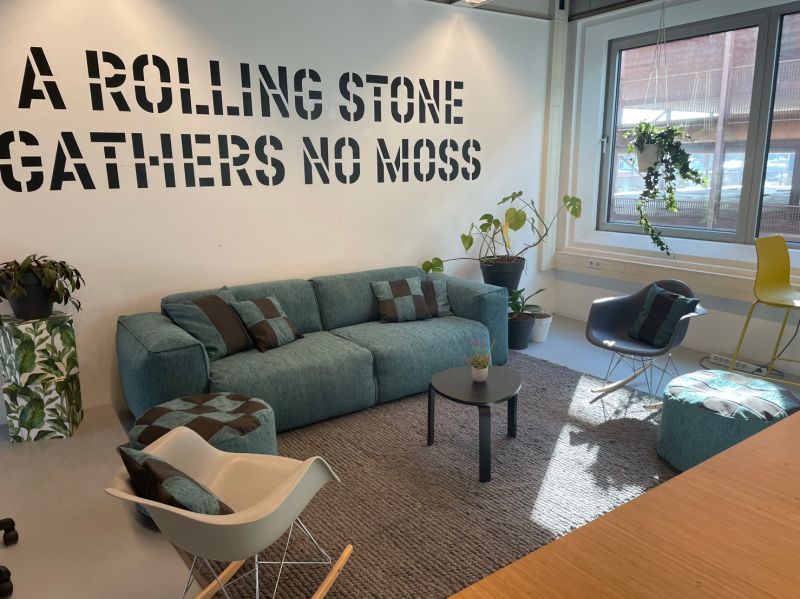
For the Municipality of The Hague, we reused existing furniture in the event space of Apollo 14. Instead of buying new sofas, we upholstered the existing ones with recycled yarn and made matching ottomans and cushions.
Using merchandise or textile upcycling?
Do you want to know what is possible with your textile streams or how you can combine upcycling with new production?
Schedule a meetingFrequently asked questions about textile upcycling
What is the difference between upcycling and recycling?
In recycling, textiles are broken down into fibers. In upcycling, we reuse the material directly, maintaining quality and appearance.
Can you produce small quantities?
Yes. Thanks to local production, we also work with pilots and small series, ideal for testing.
Can logos be removed or adjusted?
Yes. Logos can be made invisible, remain visible, or be creatively reused.
Can upcycling be combined with new workwear?
Sure. Many organizations combine upcycling with new sustainable workwear.